Mud Season Can Change the Tree Equipment Without Canceling the Whole Project
Soft roads and wet lawns may delay a crane, but climbing or lighter equipment can sometimes keep part of a New Hampshire tree project moving.
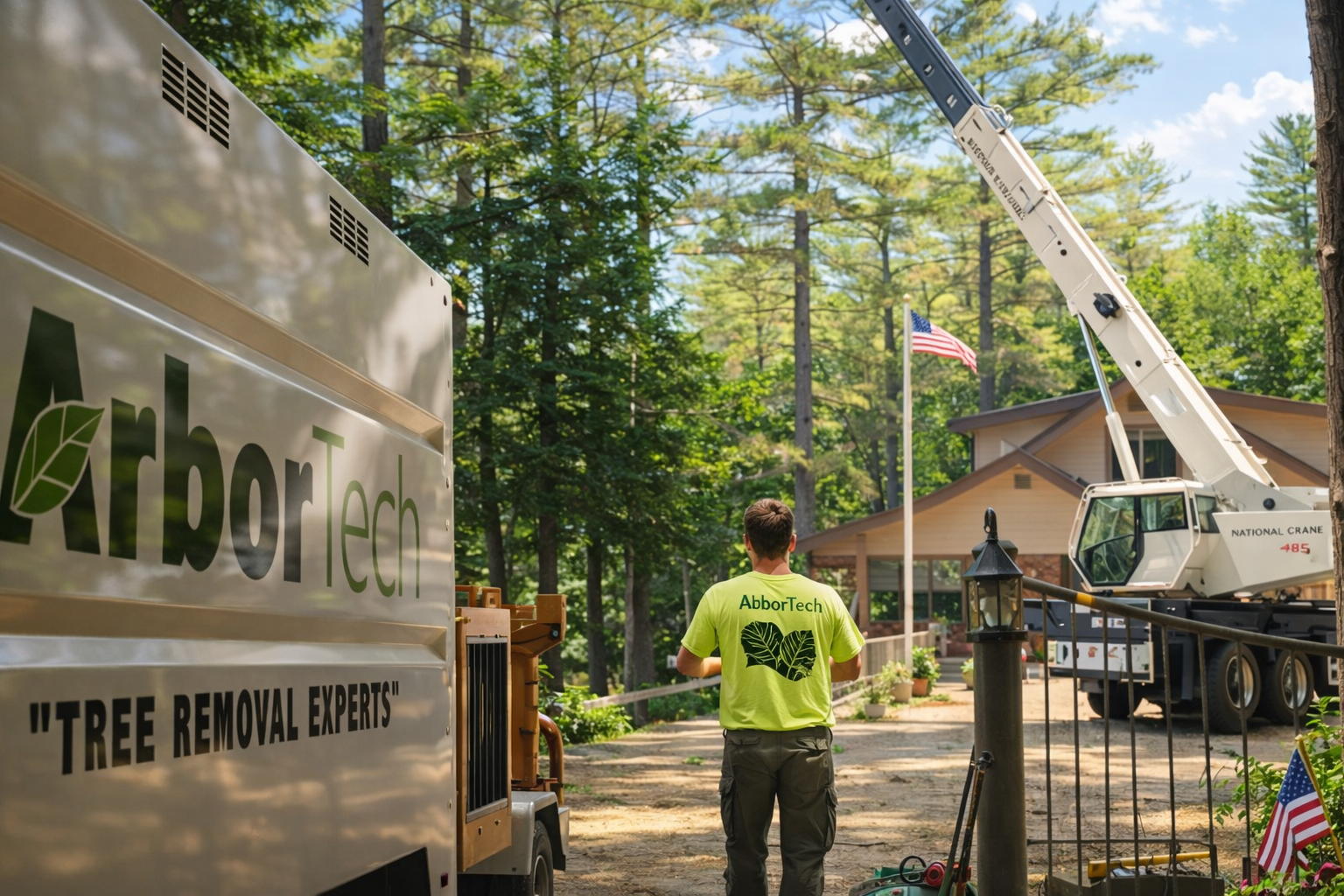
A homeowner may schedule tree work during winter and expect the project to begin as soon as the snow disappears.
The snow disappears first. Firm ground may take longer.
New Hampshire mud season can soften lawns, gravel roads, shoulders, and narrow access routes enough that equipment placement becomes the main project question. Our local service pages explain that crane work may need to wait for firmer conditions while climbing or lighter equipment may sometimes proceed sooner.
That does not mean the tree no longer needs work. It means the crew may need to change the equipment, separate the project into phases, or choose another date.
A crane needs more than open sky
Homeowners often look at the tree and decide whether a crane can reach it. The crew also has to consider where the crane will sit.
A usable crane location depends on factors such as road or driveway width, surface condition, grade, underground utilities, septic areas, shoulder stability, turning room, distance to the tree, overhead lines, traffic control, and soil bearing.
We use crane-assisted work for difficult removals near structures, on tight properties, and around oversized trees. Our town pages also note that saturated ground may require rescheduling a crane day to avoid deep rutting or unstable setup.
The crane decision therefore cannot be made from a photograph of the canopy alone. Related access planning for mountain and rural lots appears on pages such as Groton, Waterville Valley, and Ashland.
Climbing places a different load on the property
A climbing crew still needs access and a work zone, but it may not require the same heavy setup as a crane.
The arborist can climb the tree, establish rigging, and lower sections into controlled areas. Ground crew members handle ropes, wood, brush, and cleanup below.
That approach may be useful when the tree structure supports climbing, appropriate rigging points are available, the drop and lowering zones can be controlled, heavy crane access is the main obstacle, the work can be completed without unacceptable property damage, and the tree is not in a condition that makes climbing unsuitable.
Climbing is not the automatic backup plan for every crane project. The arborist still has to evaluate the tree, targets, wood condition, access, and crew safety. Selective pruning can also be the better first move when the goal is reducing load rather than removing the entire tree.
One project may use several methods
A tree-care estimate does not always describe one machine performing every task.
We may use climbers for pruning or sectional removal, rigging to lower wood near structures, a crane for large or difficult picks, ground protection beneath equipment, alternate access routes, smaller machinery for cleanup, and stump grinding during a later visit.
Separating the work can make sense when the priority is removing damaged branches now while the stump or lower-priority tree waits for better ground. Ask which tasks depend on heavy equipment and which could move forward under another plan.
Send access photos before the estimate
Our Groton service guidance asks property owners to share road grade, gate width, and turnaround photographs when requesting a quote. That advice applies well beyond one town.
Useful photographs include the full tree from a distance, the tree in relation to the house or other targets, the driveway entrance, the narrowest gate or road section, the steepest grade, the likely crane or equipment area, soft or wet ground, septic or utility markings if known, the available turnaround, and the route from the street to the tree.
Photos do not replace the site visit. They help us arrive with a more accurate idea of what needs to be evaluated. More tips for estimate photos live on the blog.
Protecting the lawn can justify waiting
A homeowner may be willing to accept some tracks or disturbed grass to complete an urgent project. There is still a difference between ordinary wear and preventable damage caused by placing heavy equipment on ground that cannot support it.
We note that we use ground protection and alternate routes where possible but may delay crane work when saturated soil makes rutting likely.
The decision should account for the urgency of the tree condition, the likelihood the ground will improve soon, the availability of another safe work method, the value of the lawn, drive, stonework, or landscaping beneath the route, the cost of repairing access damage, and whether frozen ground may provide a better future window.
Waiting is not always the right answer. Proceeding with the heaviest method on the wettest day is not automatically the right answer either.
Frozen ground can sometimes be the better access season
Winter is not always the obstacle.
For some rural, mountain, or back-road properties, frozen ground can support equipment better than spring soil. Our Groton page specifically notes that mud season may delay cranes while frozen ground can help access.
That does not mean every project should be moved to winter. Snowbanks, icy grades, road width, daylight, tree condition, and weather still affect the plan.
It does mean a homeowner planning non-emergency work should ask whether the best equipment window is later this summer, next winter, or after the ground dries rather than assuming spring is always easiest.
Stump grinding may belong on another date
The tree can be removed while the stump remains temporarily.
Stump grinders have their own width, weight, access, rock, and soil considerations. Our Waterville Valley guidance says grinding may proceed where soil allows, while another solution may be discussed when conditions are unsuitable.
Keeping stump work separate can prevent one difficult access issue from holding up the more important tree work.
Ask what changed when the schedule changes
When we recommend postponing or changing equipment, ask for a plain explanation.
The answer should identify which access area is unsuitable, which equipment is affected, whether climbing remains possible, what work can be separated, what conditions need to improve, what property damage the change is intended to avoid, and whether urgency changes the recommendation.
We serve Belknap, Grafton, and Merrimack counties. Call 603-491-5183 or request an estimate with access photos and the tree's relationship to nearby buildings. Related association planning is in a Waterville Valley HOA needs a tree list before it needs a tree crew.
Not Sure Whether Mud Season Changes Your Tree Job?
Send access photos and tell us what is near the tree. We will explain which equipment fits the ground conditions and what can wait.