Tree Work on a Winnipesaukee Island Starts at the Dock
Island tree work requires more than an arborist and a saw. See how boats, barges, landing space, climbing, and cleanup shape a Winnipesaukee project.
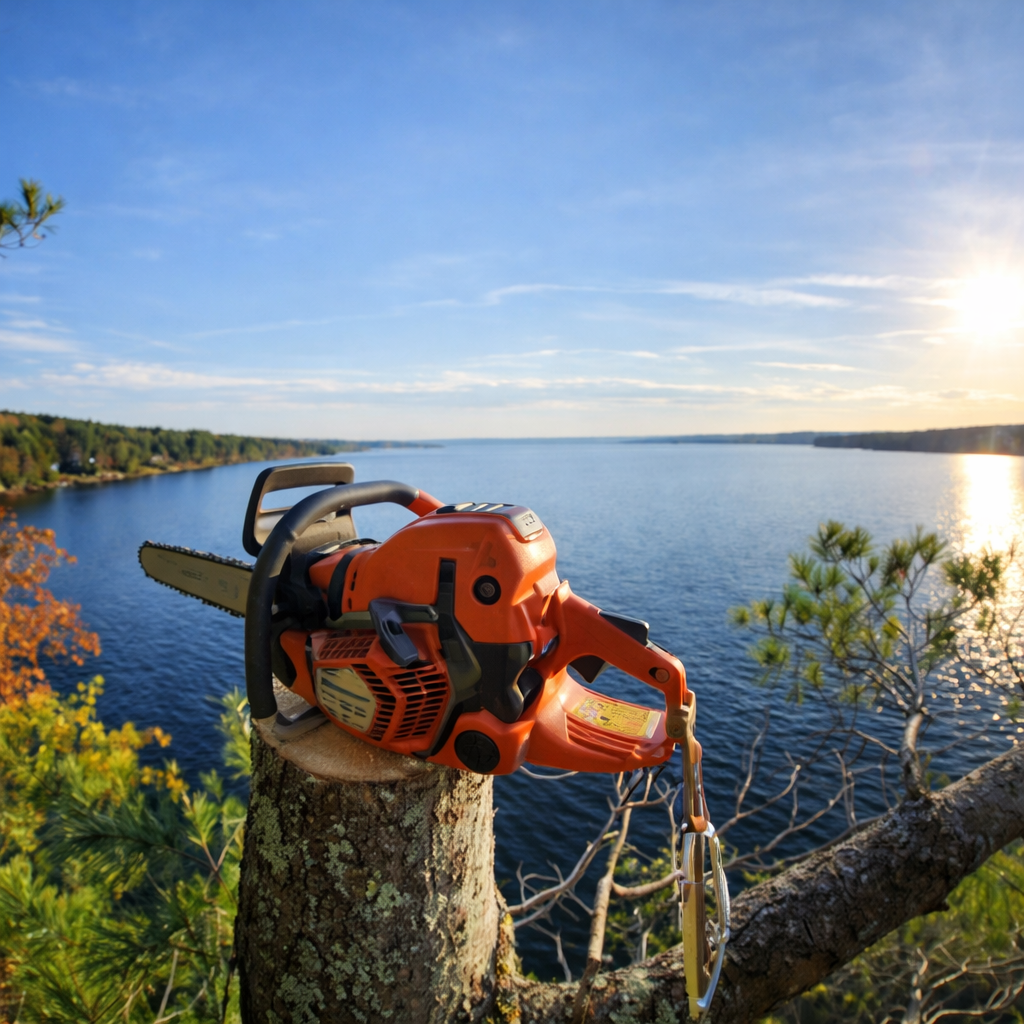
On the mainland, the driveway is usually the first access question for a tree crew. On a Lake Winnipesaukee island, the job starts one step earlier. The crew, climbing gear, saws, rigging equipment, and anything else needed for the project first have to cross the water.
That changes much more than the travel time.
We have a separate approach for our Winnipesaukee Islands tree service. Depending on the job, people and equipment arrive by boat or barge. We do not use cranes on island jobs, so removals that might be crane-assisted on a mainland Lake Winnipesaukee lot are planned around climbing and rigging instead.
For an island owner, this is why the estimate begins with the property, not just the tree.
The dock is part of the work site
A good tree photo is still useful, but we ask island customers for dock and mooring information as well. The crew needs to understand where it can land, what equipment can come off the boat or barge, and how everything will move from the shoreline to the work area.
A wide dock with a direct path into the yard creates one kind of job. A small landing followed by granite steps and a narrow trail creates another. Two cottages may have trees of similar size but require completely different work plans simply because of access.
That is why an island estimate benefits from a set of photos rather than one close picture of the trunk. Show the dock, the route from the water, the cottage, nearby structures, and the full tree. If the property has stairs, tight corners, retaining walls, or a shared beach, include those too.
These are not minor logistics. They determine what can reasonably be transported to the site and how cut material can be handled afterward. Browse the gallery for how waterfront and shoreline jobs look once crews are on site.
Without a crane, rigging carries more of the job
We use crane equipment for appropriate mainland tree work around the Lakes Region, but our island page is clear that cranes are not used on the islands. Complex island removals are handled with climbing, rigging, mechanical advantage, and planned anchor points.
That matters on properties where the tree stands close to a cottage, dock, path, or shoreline and there is no open lawn available for large sections to come down.
Instead of picturing a whole tree falling into an empty yard, think of the removal happening in pieces. An arborist can work through the crown and trunk while the crew manages individual sections from below. The exact method depends on the tree and the site, but the basic idea is that the property itself dictates how the wood comes out.
It also means island work can move more slowly than a similar project on an easy mainland lot. We specifically note that water transportation, limited staging space, and slower handling of cut material are part of the additional cost of island projects. Selective pruning can be a better fit when the tree can stay and clearance is the real issue.
Stump work has its own access question
A tree can be removed even when a stump grinder cannot realistically reach the same location.
We offer stump grinding on the islands when a grinder can be moved by barge and landed without creating problems for the property. If that is not practical, we discuss alternatives such as cutting the stump low and allowing it to decay over time.
This is worth discussing during the original estimate rather than after the tree is already down. Tell the arborist what you want to do with the location afterward. If a new path, planting, or other project is planned for the same spot, stump access may be more important than it would be in a wooded corner that will remain unchanged.
The same thinking applies to cleanup. Branches and trunk sections still have to be handled even though the job arrived by water. A crew that cannot simply back a chip truck up to the work area needs a different plan for moving material through the property. Shoreline rules may also apply, so review shoreland protection when work sits near the water.
Island scheduling has to respect the lake too
Wind and waves can affect the ability to transport crews and equipment safely. We note that storm-response timing and scheduled island work depend partly on navigable conditions, and that same-day mobilization may not always be possible even when the tree problem itself is urgent.
Shared shoreline areas can add another consideration. Some island properties use tight coves, common beaches, or other spaces where work activity affects nearby owners. We consider those conditions when scheduling lifts, transport, and noisier work.
None of this makes island tree work unusual to someone who owns property on Winnipesaukee. Boats and access are already part of everyday life. It simply means the tree company has to plan around the same realities.
Give the estimator the property story, not just the tree story
When requesting island work, tell us the island and bay, how the property is reached, what the landing is like, and where the target trees sit in relation to the cottage and shoreline. Wide photos are more valuable than a series of tight bark pictures.
That allows us to think about transportation, equipment, climbing, rigging, stump access, cleanup, and shoreland considerations before committing to a work date.
For company credentials that apply across island and mainland work, read what TCIA accreditation tells you about ArborTech NH. More seasonal tips live on the blog.
We serve island and mainland properties throughout the Lakes Region. Island owners can call 603-491-5183 or use our estimate request and include photos that show both the trees and how the crew would reach them. Email info@arbortechnh.com when sending a larger photo set helps.
Planning Island Tree Work?
Send dock photos, mooring notes, and wide shots of the trees. We plan boat access, climbing, and cleanup before the crew leaves the mainland.